

Silver Market Worth 65.35 Kilotons by 2035, Rising from 40.42 Kilotons in 2025
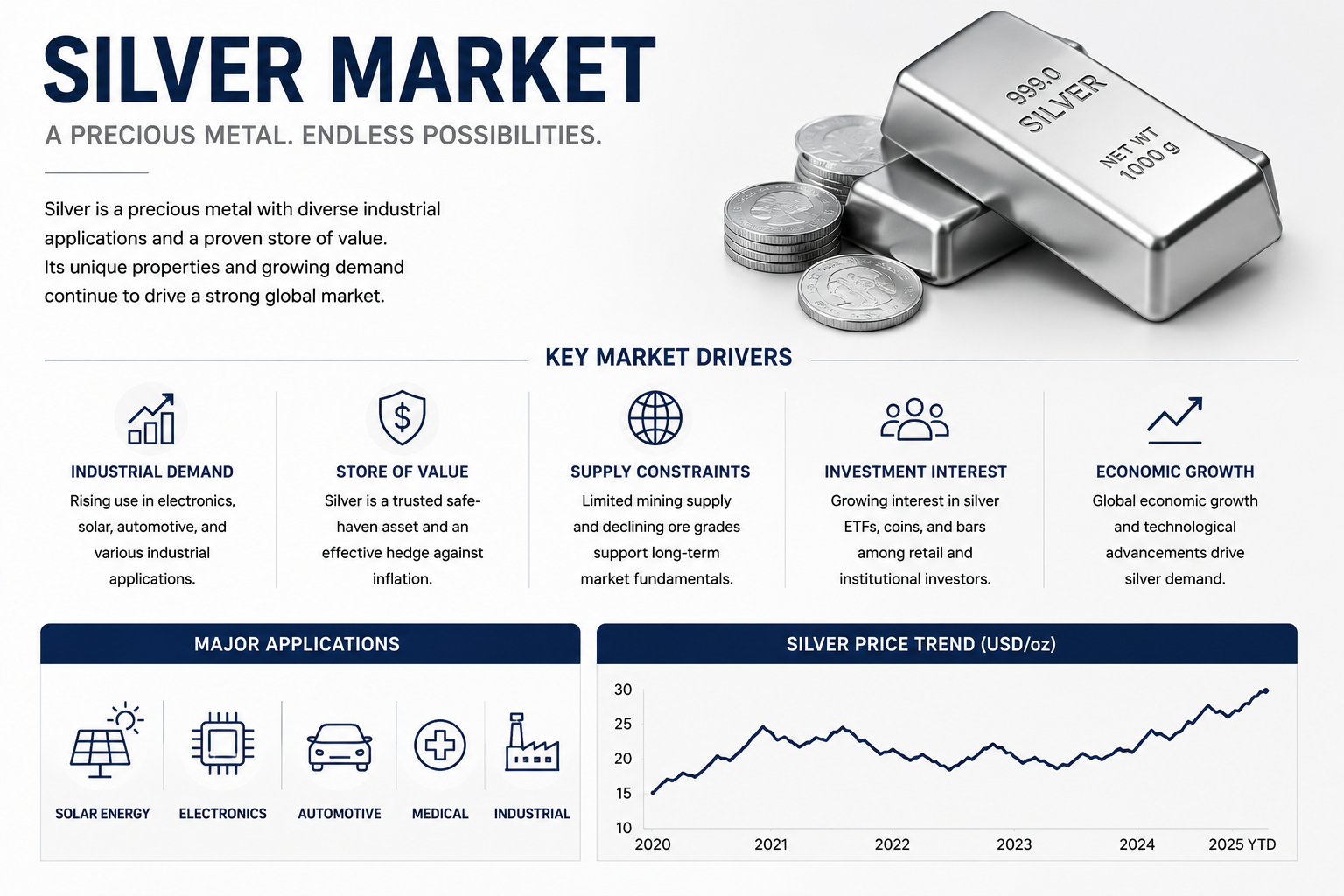
Silver Market
Asia-Pacific accounted for 53.4% of global Silver Market consumption in 2025, underpinned by China's solar module output and India's electronics expansion.
GA, UNITED STATES, July 6, 2026 /EINPresswire.com/ -- For centuries, silver has lived in gold's shadow—a precious metal prized for jewelry, coins, and investment bars, but rarely commanding the strategic attention of policymakers or industrial planners. That narrative is changing rapidly. According to a comprehensive analysis by Market Research Future, the global silver market consumed an estimated 40.42 kilotons in 2025 and is projected to grow at a 4.95% CAGR through 2035, reaching approximately 65.35 kilotons. What makes this growth remarkable is not its pace, but its composition: silver is transitioning from a store of wealth to an irreplaceable industrial material, embedded in the technologies that will define the next decade of global development.From Ornament to Infrastructure
Jewelry and silverware still capture roughly 28% of silver market volume, driven by robust cultural demand in India and Southeast Asia. Yet this traditional stronghold is being eclipsed by industrial applications that now account for the majority of global consumption. Fine silver—holding 66.6% of market volume—has become the feedstock of choice for photovoltaic paste, electronics-grade sputtering targets, and high-performance connectors. The metal's unmatched electrical and thermal conductivity, combined with its antimicrobial properties, has made it indispensable across sectors that barely registered as demand drivers a generation ago.
The structural shift is unmistakable. Electrical and electronics applications are projected to advance at a 5.15% CAGR, the fastest among all application segments, as photovoltaic and 5G end-uses scale. Meanwhile, the fastest-growing type segment—Argentium silver, at 5.10% CAGR—reflects demand for tarnish-resistant alloys in medical devices and premium jewelry, signaling how silver's material science properties are opening new frontiers.
Download Report Sample Copy: https://www.marketresearchfuture.com/sample_request/8002
The Solar Imperative
No single factor dominates silver demand like the global expansion of solar photovoltaics. The International Energy Agency's World Energy Outlook projects that global solar PV capacity must reach 5,400 gigawatts by 2030, up from roughly 1,600 gigawatts at the end of 2023. Each gigawatt of crystalline silicon capacity requires approximately 10 to 15 tonnes of silver paste for cell metallization. China's National Energy Administration approved 217 gigawatts of new solar in 2024 alone—a figure that guarantees sustained silver offtake regardless of short-term price fluctuations.
Technological evolution in solar cell architecture tells a nuanced story. Legacy thick-film paste formulations loaded 100–120 milligrams of silver per cell; newer heterojunction and TOPCon architectures have cut this loading. Yet the reduction in per-cell consumption has been overwhelmed by the explosion in total cell volumes. The U.S. Department of Energy's Solar Futures Study projects cumulative American solar installations to surpass 1,000 gigawatts by 2035, while India's PM Surya Ghar project targets 10 million residential rooftop systems by 2027. Even as the industry thrifts silver per watt, aggregate demand continues to climb.
5G, Electrification, and the AI Data Center Boom
The telecommunications sector is emerging as a powerful secondary demand pillar. Global 5G base-station installations are expected to exceed 15 million units by 2028, each employing silver-palladium thick-film pastes in filters, antenna feed networks, and high-frequency connectors. Millimeter-wave deployments in the 24–39 gigahertz bands demand conductor tolerances where silver's superior conductivity becomes a non-negotiable specification. The sector is projected to absorb an incremental 800–1,200 tonnes annually by 2030—a channel that barely existed five years ago.
Automotive electrification adds another structural floor. The transition to 800-volt electrical architectures in battery electric vehicles requires silver-plated busbars and fast-charge connector contacts rated for sustained high-amperage cycles. With global EV sales projected to reach 30 million units per year by 2030, each using roughly 0.5–1.0 ounce of silver in powertrain and charging components, the automotive sector represents demand that did not exist in the previous decade's consumption profile.
Perhaps most intriguing is the artificial intelligence boom. The explosion of AI training and inference workloads is driving a data center construction boom that the International Energy Agency estimates will double global data center electricity consumption by 2030. Silver-containing thermal interface materials, high-frequency connectors, and printed circuit board finishes are embedded in every server rack. As semiconductor nodes shrink below 3 nanometers, silver's role in advanced packaging—particularly hybrid bonding and redistribution layers—could open a high-value channel that barely exists today.
The Geography of Demand and Supply
Asia-Pacific commands roughly 53.4% of global silver consumption, reflecting China's manufacturing dominance and India's rapidly expanding electronics and solar sectors. The region is forecast to post the fastest regional CAGR of 5.30% through 2035. China's position as manufacturer of over 80% of global solar cells and a major share of consumer electronics anchors this dominance. India is the fastest-growing consumption center, with demand rising on three fronts: the Production Linked Incentive scheme's electronics manufacturing subsidies, robust wedding-season jewelry purchases, and the PM Surya Ghar rooftop solar program.
North America accounts for approximately 18.2% of consumption, with the United States driving growth through solar IRA credits and defense electronics procurement. Europe follows at 16.8%, where the REPowerEU plan and the Critical Raw Materials Act are channeling investment into domestic silver refining and solar deployment. The EU's designation of silver as strategically important under the Critical Raw Materials Act signals a policy recognition that was unthinkable a decade ago.
Yet supply geography tells a different story. Mexico and Peru account for roughly 40% of global mine production, concentrating supply in jurisdictions undergoing regulatory reform. Peru's average permitting timeline for new projects has extended to 7.2 years, up from 5.1 years in 2019, while Mexico's 2023 mining law reforms have introduced community-consent provisions that have effectively halted three major projects in Zacatecas. These constraints tighten the availability of newly mined silver, creating periodic shortfalls that must be covered through above-ground inventories and secondary recovery.
Substitution, Recycling, and the Circular Economy
The silver market is not without headwinds. Copper-plated photovoltaic ribbon technology can replace up to 80% of silver in interconnect wiring, and aluminum-doped zinc oxide transparent conductive layers are under development as silver-free alternatives. Silver thrifting in next-generation solar cells has reduced consumption per watt by roughly 30% over the past decade, with a further 15% reduction targeted by 2030. Price volatility above USD 30 per troy ounce incentivizes these substitutions, creating a ceiling effect on demand growth during spot price surges.
Yet the circular economy offers a counterbalance. End-of-life photovoltaic panels are projected to generate 5 million tonnes of waste annually by 2035, containing recoverable silver valued at over USD 1 billion. Japan and the European Union are implementing extended producer responsibility schemes mandating silver recovery rates above 85%. Secondary recovery currently meets about 15–18% of annual demand, and while it cannot fully replace primary mining, it moderates dependence on geopolitically concentrated supply.
Purchase Now: https://www.marketresearchfuture.com/checkout?currency=one_user-USD&report_id=8002
The ESG Premium and Responsible Sourcing
Institutional investors managing over USD 40 trillion in assets now apply ESG screens to commodity supply chains, and silver is no exception. The London Bullion Market Association's Responsible Silver Guidance and the Responsible Minerals Initiative's audit protocols are creating a two-tier market: certified responsibly sourced bars trade at 2–4% premiums over uncertified material. Blockchain-enabled traceability from mine to end product is becoming a value-added service, commanding premiums of 3–5% on ethically certified silver. Miners and refiners that invest in traceability, community engagement, and emissions reduction stand to capture differentiated pricing through 2035.
The silver market's evolution from precious metal to critical industrial commodity reflects a broader truth about the materials powering the twenty-first century. With demand projected to rise from 40.42 kilotons to 65.35 kilotons by 2035, consumption geography tilting toward Asia-Pacific's manufacturing and energy transition, and supply constrained by regulatory and geological realities, silver has become a structural beneficiary of decarbonization and digitalization. The "poor man's gold" is no longer poor—nor is it merely gold's understudy. It is an essential enabler of solar power, electric mobility, 5G connectivity, and artificial intelligence. For investors, policymakers, and industrial planners, silver's strategic importance can no longer be overlooked.
Source: https://www.marketresearchfuture.com/checkout?currency=one_user-USD&report_id=8002
Related Report
Syngas Market https://www.marketresearchfuture.com/reports/syngas-market-7487
Melamine Formaldehyde Market https://www.marketresearchfuture.com/reports/melamine-formaldehyde-market-4745
Crumb Rubber Market https://www.marketresearchfuture.com/reports/crumb-rubber-market-25500
Quartz Market https://www.marketresearchfuture.com/reports/quartz-market-18835
Market Research Future
Market Research Future
+1 855-661-4441
email us here
Legal Disclaimer:
EIN Presswire provides this news content "as is" without warranty of any kind. We do not accept any responsibility or liability for the accuracy, content, images, videos, licenses, completeness, legality, or reliability of the information contained in this article. If you have any complaints or copyright issues related to this article, kindly contact the author above.
